MOTHER – THE CONTEMPORARY TALE OF PIETY IN THE ABYSS OF UNCERTAINTY

LUCREZIA BAZZOLO | ROME, 30 JANUARY 2026
Desolation, abandonment, slowness: these are just some of the countless and unpredictable sensations evoked by the experience of Mother, the installation on display at MAXXI, concluding on 18 January 2026.
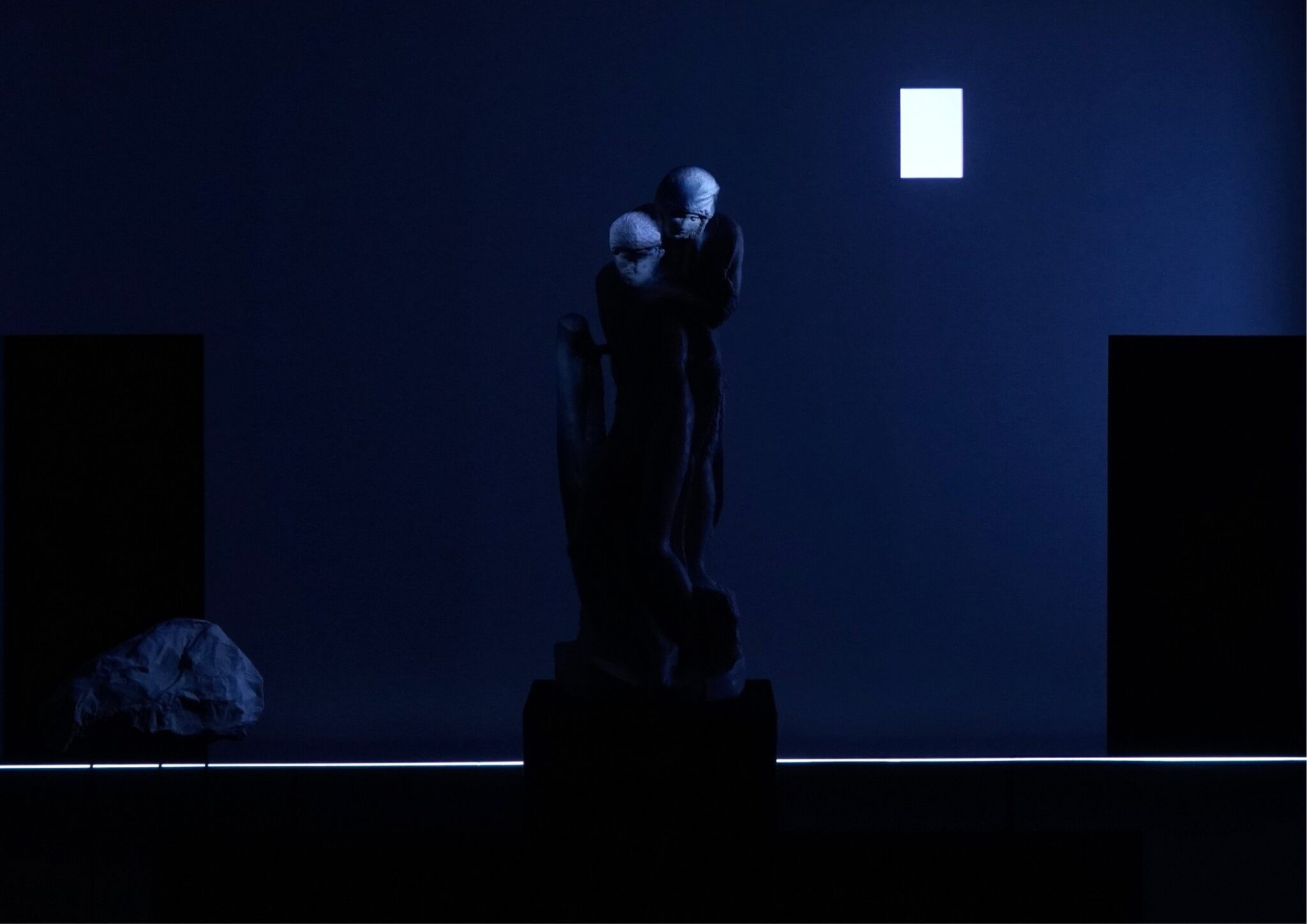
A vivid and unusual experience, an invitation to humanity through the vision of Michelangelo’s Pietà Rondanini, a plaster cast commissioned in 1953 from the renowned conservator and restorer Cesare Gariboldi.
In an initial whirl of absence of light and the delicacy of a celestial sound, both intangible and at the same time violent and vibrant, the harrowing vision of the unfinished sculpture comes to life, revealing itself to the spectator’s eye through the complex interplay of lights and symphonies, respectively conceived and designed by American director and artist Robert Wilson and independent composer Arvo Pärt.

(Michelangelo, Pietà Rondanini, MAXXI, Rome)
Darkness and shadows nurture the space and, in their chasing and following, write a score in which a fragile physicality lives, a body completely abandoned to another and therefore profoundly human.
An intersection of limbs aimed at supporting one another, an interaction that evokes ancestral feelings, belonging, and the primordial echo of the Son’s body to that of His Mother, a return to one’s uterine origin.
It is through this humble and compassionate coexistence that one experiences a sublime sense of unease and calm, a stasis unknown in an era of readiness, speed, and the importance of physical and moral prowess, to the detriment of a true and deeper understanding of reality.
In its manifestation, the work makes the viewer wait before revealing itself in all its incompleteness, in the courage of showing itself unfinished in the time of concreteness, of relentless doing, of life becoming social performance.

(The Hand of God, 1896, Auguste Rodin)
A room whose walls become a music of contrasts, of oxymorons, to convey the shock and brutality inherent in beauty, to express its contradictions without attempting to explain them, without giving answers, but intending to provoke questions.
What does abandonment mean in contemporary life? Is humanity still capable of it? How difficult has it become to reflect without the need to draw immediate conclusions, to remain in the oblivion of one’s mind, adrift, arriving at the boundless lands of thought?

In Mother, art once again becomes a mirror of society, reflecting discomfort, a general unease that nourishes the days and unsettles them, with the silent quiet of a hurricane about to unleash.

Perhaps this is exactly the intention of Robert Wilson and Arvo Pärt: to revolutionize the language of art, to read and speak it with a critical spirit and a desire to understand reality, the decisive direction in which we are heading.
Sublimating pain before an audience that can do nothing but witness it, proposing to remain in darkness, in uncertainty, simply asking to observe, not as an active visitor but by shedding one’s hesitations to become a bridge with the work itself, to connect with the beauty of not knowing what will happen.
Every intention to be conveyed in this exhibition arises from nothing, from an apocalyptic absence, from a void that seems unfillable yet becomes overwhelmingly full in a continuous crescendo; the intensity of non-control and the difficulty in trusting another opens the gaze toward a crucial reflection, socially relevant as never before, concerning humanity in its entirety, as individual and collective, concerning its audacity and its becoming vulnerable once again.
The expression “Hard times are interesting times” serves here as a new paradigm, in the shared desire to find new beginnings in the flow of days that carry the taste of an ending.

(Study for the Portrait of Renato Gualino, 1922-1923, Felice Casorati)