
REDAZIONE| ROME, 9 JANUARY 2026
Just as behind a great man there is often a great woman, so behind a great jewelry signature there is a workshop of master goldsmiths who bring ideas to life. Creators need makers, in the etymological sense of the word, so that metals, stones, enamels, and materials can be shaped and combined to form masterpieces.
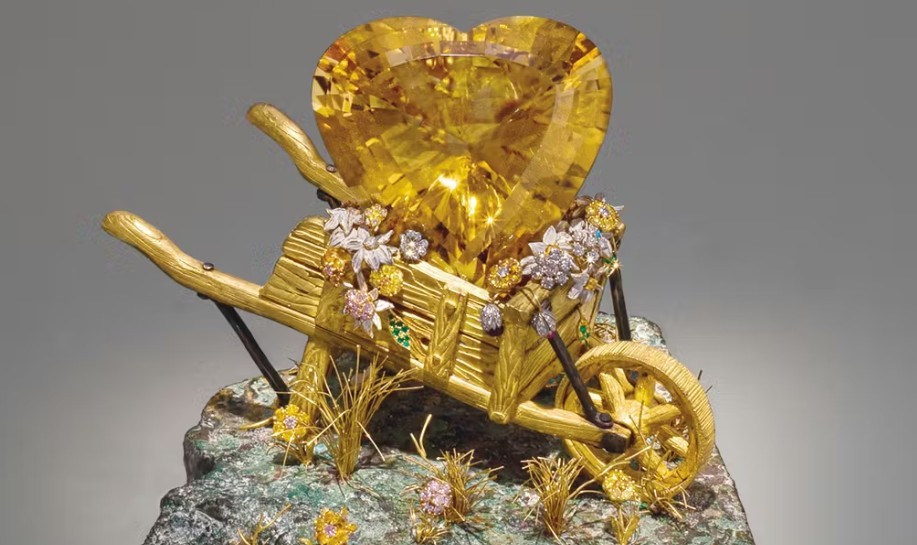
The major Maisons in most cases have in-house workshops, but they often also entrust their creations to external ateliers that produce discreetly, remaining in the shadows. Thus the almost hidden Carvin French atelier of Carponcy and Chervin gives life to creations for Verdura, Bulgari, Van Cleef & Arpels, Cartier, Tiffany, and others.
André Chervin was born in Paris in 1927 into a Jewish family. His father Samuel emigrated to France from Poland in 1904 due to antisemitism. His mother Sarah, Parisian, came from a family active in the goldsmith world, with shops in various cities. They married in 1917 and opened a jewelry and watch shop in the Marais. On 14 June 1940, the troops of the Third Reich entered Paris. Samuel and Sarah lost their shop due to “Aryanization,” and in 1942, to escape the concentration camps, they fled with their children to Vichy France. In 1945 they returned to Paris and, through legal action, managed to regain possession of the shop, which they ran until retiring from business in 1960.

After completing high school, André enrolled in the “Haute École de Joaillerie”, where he learned various goldsmithing techniques. After completing his military service, he finished his apprenticeship, becoming a fully trained goldsmith capable of managing the entire production process. On 15 February 1951, “just to have a look,” he embarked at the port of Le Havre for New York, where he had relatives. After a few days in the United States, responding to a newspaper advertisement, he began working in a jewelry shop. A family friend, Alma Zimmer, provided him with a dictionary to help him understand English. In 1954 Alma became his wife and gave him two children: Ronald (1961) and Carole (1964). Chervin later worked for two other ateliers and in 1952 joined the important workshop of Louis Feron.

Louis Feron (1901–1998) was born in Rouen and completed his apprenticeship in Paris. In 1933 he won the title of “Best chaser, goldsmith and silversmith of France” with the work “Head of John”, now in the Museum of Fine Arts, Boston. A sculptor, chaser, and goldsmith, he was honored at the Sorbonne, but in 1934 emigrated to Costa Rica, where he opened his own workshop. He was appointed professor at the School of Public Works. He participated actively in the cultural life of the country and in 1987 received a commendation from the Costa Rican government for his “Great contribution to the artistic and cultural heritage of the Nation.”

(Louis Feron)
In 1945 Louis Feron, encouraged by Rockefeller—who had been impressed by his work in San José—moved to New York. In 1951 he obtained American citizenship. In the Big Apple he established his studio, where he created jewelry and sculptures for private clients and for the most important jewelry houses. His works are held in museums in Paris, Boston, Manchester, Virginia, and in the Cathedral of Detroit. In 1995, thirty-five of his works were exhibited at the Musée des Arts Décoratifs in Paris. Among his students, in addition to Chervin, was also Pierre Etienne Lahaussois, likewise French.
In 1954 André Chervin and Serge Carponcy, both goldsmiths trained under Feron, opened their own workshop on the first floor of a building at 16 East 52nd Street, in the heart of New York’s luxury jewelry district. The economic boom following the Second World War favored the new venture. The atelier took the name “Carvin French,” combining parts of the partners’ names and emphasizing their French origin as a guarantee of excellent craftsmanship. The activity was organized according to the tradition of the “Finest workshop in the world” and immediately achieved a level of excellence that ensured an elite clientele. From the initial two goldsmiths, by 1980 the atelier grew to employ 40 master goldsmiths in addition to staff.

The collaboration with Fulco di Verdura began in 1958 and developed into the creation of true works of art. Mutual trust was so strong that in 1964 approximately 50% of the production of the great Italian creator’s jewelry was handled by Carvin French.
In 1964 work began with Tiffany, collaborating with its most important designers such as Donald Caflin and Angela Cummings; from their synergy emerged ideas for significant jewelry pieces.
In 1970 André met Nicola Bulgari and began an important collaboration. Nicola’s esteem for André was so great that he commissioned from him a magnificent necklace for his wife Beatrice.
In 1983 Serge Carponcy retired from business and Chervin became the sole owner. The work was demanding. André supervised the activity of each individual goldsmith meticulously and without compromise. Each single piece required the work of eight to thirteen different artisans. Many of these could enter the atelier only after twelve to fifteen years of experience. He worked until a late age, and the tradition is carried on by his family.
