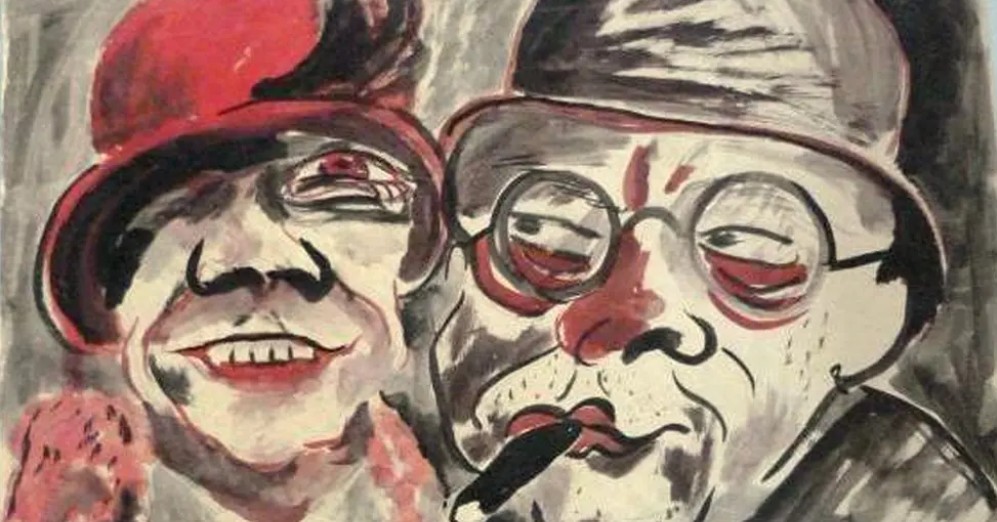
DEGENERATE ART AND THE GURLITT COLLECTION


PROF. SERGIO ANSUINI| ROMA 17 OTTOBRE 2025
(Part Two)
Hildebrand Gurlitt (1895–1956), “one-quarter Jewish” according to the Nuremberg Laws, was born into a family of artists. His father was an architect and art historian, and his sister Cornelia, a successful Expressionist painter, was in contact with Chagall. After graduating in 1925, Hildebrand became the first director of the König Albert Museum in Zwickau, Saxony. One of his first exhibitions was dedicated to the Expressionist Max Pechstein. In 1926, he entrusted the design and decoration of the museum to the Bauhaus. He purchased and exhibited works by Kandinsky, Klee, Kokoschka, and Munch—artists he personally knew. In 1930 he moved to Hamburg, where he became curator and general director of the Kunstverein (art association) until 1933, when he was dismissed along with others by the Nazis.

(Hildebrand Gurlitt)
He then began his activity as an art dealer and art historian, buying and selling works. He entered the National Socialist orbit and became one of the four dealers commissioned to sell paintings classified as “Degenerate Art.” He personally acquired many works legally. After France’s defeat, he was tasked by Goering, along with others, to procure artworks for the planned Führermuseum that Hitler wanted to build in Linz. Other works entered the personal collection of the Field Marshal, and others into that of Gurlitt. In addition to artworks for his collection, this assignment also allowed him to amass a considerable fortune.

(Hitler visiting the Degenerate Art exhibition)
In 1945 he was arrested by the Americans with 115 artworks, but thanks to his Jewish ancestry, he was released, and the seized works were returned to him, as they were recognized as his legal property.
In 1947 he resumed his activity as an art dealer and historian, organizing traveling exhibitions, including in the United States. In 1948 he was appointed director of the Art Association for the Rhineland and Westphalia. He died in a car accident in 1956. For his commitment to defending modern art, a street in Düsseldorf was named after him.
Decades passed, and the memory of Hildebrand Gurlitt faded. His vast art collection, amassed through years of work—but also through opaque dealings in Nazi Germany and occupied France—first passed to his wife and then to his son.

(Max Beckmann, Zandvoordt Strandcafé, 1934)
Cornelius Gurlitt (1932–2014) lived a reclusive life, always guarding the treasure he had inherited in his homes in Germany and Salzburg. He quietly sold a few works to support himself, attracting little attention. On September 22, 2010, seventy-seven-year-old Cornelius, while returning by train from Switzerland—where he had gone to withdraw funds for his precarious health—was stopped for a routine check. He was carrying €9,000, below the maximum legal limit of €10,000. He mentioned selling a painting, and the matter seemed to end there. However, the German bureaucracy had already been set in motion. Suspected by Augsburg tax officials of evasion, his home was searched, and 1,406 artworks were discovered. The collection included works by Cézanne, Monet, Matisse, Renoir, and Old Masters. About 500 works were attributed to Degenerate Art.

(Cornelius Gurlitt)
The international media circus erupted over the “Nazi hoard,” exaggerating its value and labeling everything as looted from Jews and occupied nations. It became an international scandal that dominated the press for a long time. Cornelius fought back, and a legal battle ensued in which he was acquitted of tax evasion charges. The confiscated works were returned to him, also due to a law that extinguished restitution claims after thirty years. Old and ill, Cornelius nevertheless chose to return some looted works and accepted provenance investigations. The artworks kept in his Salzburg home could not be seized by German authorities and remained in his possession.
In 2014, having regained ownership of his collection, he died, leaving it as a bequest to the Kunstmuseum in Bern. He explained his decision as a reaction to his treatment by the Germans. The museum accepted the works, reserving judgment on those potentially looted.

(Two curators from the Kunstmuseum Bern transport a painting by the German artist Otto Dix)