
(Part One)
The Weimar Republic (1919–1933) was a period of great social and political turmoil. The Freikorps opposed the Spartacists and the Communists in a climate of violence which, however, did not prevent the arts from expressing themselves in a condition of freedom that had been nonexistent during the Empire.
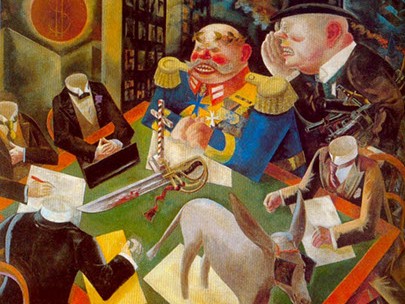
Gropius, with the Bauhaus, redefined architecture and the very concept of art. Die Brücke and later Der Blaue Reiter had anticipated German Expressionism, which after the war revealed a harsh realism that verged on brutality, with artists such as Otto Dix (1891–1969), Max Beckmann (1884–1950), and George Grosz (1893–1959).

(Poster of the Bauhaus Exhibition, July – September 1923)
In 1933 the Brownshirts imposed a complete break. For Nietzsche, art is an expression of the will to power. The regime could not tolerate artists who, through “Cultural Bolshevism” and “Judaism,” undermined the concept of idealization and the greatness of the German race and nation. The ideological apparatus enforced alignment with “the people” and persecuted Surrealism, Dadaism, Fauvism, New Objectivity, Impressionism, Post-Impressionism, and the Bauhaus.

(Otto Dix)
Within the NSDAP, positions were not homogeneous. Goebbels had admired contemporary artists and initially held views contrary to those of the party’s ideologue Rosenberg. The latter found, in his intransigence, the approval of the painter Hitler. The Minister of Propaganda promptly aligned himself and planned a major exhibition to ridicule what was defined as Degenerate Art (Entartete Kunst), in opposition to the official Nazi art.
The exhibition of Degenerate Art (Munich, 1937) displayed works taken from German museums by artists such as Chagall, Kandinsky, Klee, Picasso, Van Gogh, and Matisse, as well as, of course, the German Expressionists.

(Hitler e Goebbels)
More than 600 works were presented chaotically, with derogatory inscriptions and in cramped rooms. Quite unexpectedly, the Degenerate Art exhibition drew over two million visitors, while the regime’s official art show attracted no more than 500,000.
After Munich, the exhibition toured the main German cities. The displayed works were later offered for sale to foreign buyers. Not all found purchasers, partly due to the collapse in prices caused by the large volume of available works. The unsold pieces were destroyed.

(A room of the Degenerate Art exhibition, 1937)
In 1937 the Nazis began to confiscate “degenerate” works. A year later they passed a law authorizing their sale, and in 1939 they organized a major international art auction in Switzerland. In addition to the artworks, the artists themselves were persecuted, forcing many to flee Germany.
Four art dealers were commissioned to handle the sales—among them, Hildebrand Gurlitt.

(Wassily Kandinsky)
(Second part of the article to be published on October 19)